
It’s no secret that custom ASIC firmware is a tool that solves multiple tasks at once. Thanks to its wide functionality, it can be used in various scenarios and directly impact the efficiency of mining equipment.
In this article, we’ll take a look at another case demonstrating how BiXBiT custom firmware helps improve economic performance and increase the energy efficiency of ASIC miners.
The case involves a Paraguay-based hosting services provider that has collaborated with BiXBiT on mining firmware optimization for Whatsminer for a while. The provider urgently needed a solution for a fast relaunch of multiple miners after reboots that occurred frequently due to a specific facility design. The BiXBiT firmware tackles this problem effectively: devices reach full operation in 3 minutes, compared to 15–20 minutes on stock software.
The hosting provider and its clients are currently facing a tough economic challenge. With power rates at ~$0.042/kWh, a BTC price of ~$67,000, and a 144.39 T network difficulty, some devices have become unprofitable. Normally, operators would shut down these devices to avoid further losses.
The data center has a fleet of around 17,000 Whatsminer devices of different model types. The client is slowly transitioning to newer models, but the upgrade process is time-consuming. Based on the variables of BTC price, network difficulty, and electricity costs, internal calculations confirmed that daily returns for the M30S++ and various M50 models were already near zero or turning negative (see table below).
Shutting down the inefficient units isn’t an option for the operator, as their numbers already reach into the thousands. This would leave the hosting operator with idle infrastructure and a significant reduction in cash flow from unused electricity. Clients would also face storage fees for idle units until either the market recovers or they finish upgrading their hardware.
After consulting with BiXBiT, our partner used the built-in profile generator to unlock the entire range of operational settings. The main goal was Bitcoin mining optimization to restore a positive daily PnL across the underperforming models. It was also decided to test the remaining Whatsminer fleet, including profitable models, to identify other optimization opportunities.
BiXBiT firmware automatically analyzes each ASIC chip and optimizes frequency and voltage per hash board. This maximizes energy efficiency across all performance profiles with 3 TH/s profile increments. With around 15 profiles per device, the operator tested various TH/s and power draw configurations to optimize the mining hardware for maximum daily returns.
The table below shows the impact of specific Bitcoin mining optimization techniques on various Whatsminer models.
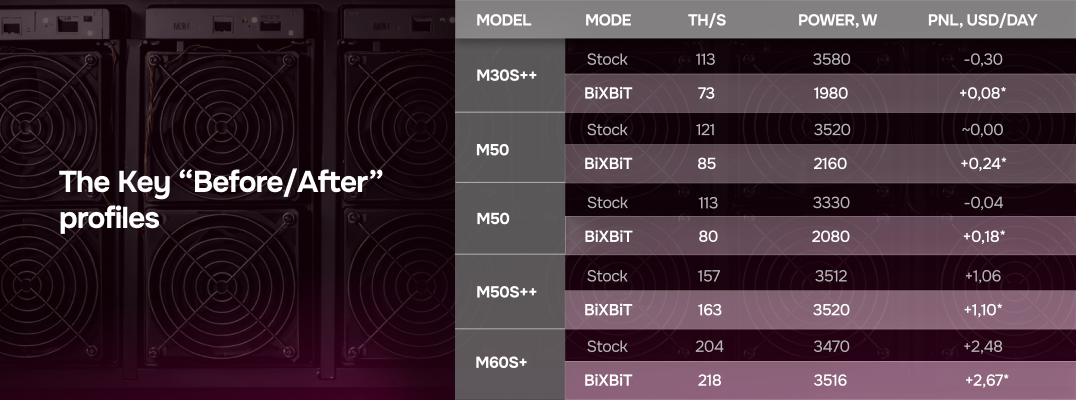
* PnL figures for BiXBiT profiles include 2.8% developer fee.
It is important to note that downvolting was not a universal solution for the entire fleet. Some units demonstrated great economic efficiency even when running on higher-performance profiles. With power draw staying relatively stable or increasing only slightly, the daily PnL in USD has grown significantly thanks to precisely tuned voltage and frequency optimizations. These optimized settings were proposed as additional options and deployed across select fleet segments where they made the most economic sense.
This resulted in a hybrid management strategy which showed how to optimize Bitcoin mining capability of each unit on the basis of its model and silicon quality. The performance modes were individually tuned to specific hardware, chip health, and client objectives, all while accounting for energy efficiency and operational expenses.

The result was a win-win for everyone involved. By keeping the hardware cash-flow positive and the infrastructure fully loaded, the business model proved its sustainability in a changing market.
Secured a predictable cash flow instead of being forced into a hardware shutdown.
Created the necessary time buffer to plan the gradual replacement of the fleet with newer, more energy-efficient models.
Provided clients with a strategy on how to increase mining profitability even when network difficulty rises.
Created a steady revenue from electricity sales.
Achieved higher client retention by offering a working solution for how to improve crypto mining efficiency in tough market conditions.
This case shows how BiXBiT firmware excels as a flexible tool for Bitcoin mining hash rate strategy optimization and managing the ASIC fleet economics. Operators can strike a balance between hashrate, power consumption, and hardware risk, all while staying profitable and predictable through every market cycle.
Want to see how BiXBiT custom firmware can benefit your specific mining environment and hardware setup?
Let’s get in touch if you want us to analyze your hardware, operating conditions, and energy costs. We’ll suggest the possible Bitcoin mining hash rate optimization strategies and firmware configurations that may boost the efficiency of your fleet.


